
-
The intent of furnishing information is to give a brief and general idea about some cables. As material, manufacturing technologies and requirements continue to evolve, the governing specifications of cables are reviewed and are amended from time to time and therefore it is advised to contact the cable manufacturers or refer to their latest catalogues for more details on the cables.
- General definition of an electrical cable:
-
An electrical cable may be defined as an assembly of one or more conductors (conductor material usually being either Aluminium or Copper) each covered with an insulating material throughout its length and are usually held together by with a sheath often made of an insulating material. Such assembly of conductor(s) used to transmit electrical energy from one point to the other is known as cable.
-
While the cable as a product must conform to the relevant standard, its components such as Conductor, insulation, sheath, armour etc. must all individually conform to the governing standards. The governing specifications may be of IS, BS, IEC, VDE, UL, BASEC, CE etc.
-
As determined by various factors such as safety, physical location, application etc. the cables may be laid underground, run overhead, laid in cable trays etc. in accordance with governing specifications of cable installation.
- Essential components of a cable
-
Necessary components of a typical cable are:
- Core(s): Conductor is known as a core of the cable. A cable may have more than 1 core.
- Insulation: Non conducting material with specified dielectric strength over the conductor is known is insulation.
- Inner Sheath: An insulating material taped or extruded over the insulated cores required to bind all the cores of a cable together if the cable has more than one core (multi core). Inner sheath is not usually required in single core cables.
- Armour: Armour is a set of metallic wires or strips that are provided helically over the inner sheath (over the insulation in case of single core cable) and run progressively along the entire cable length primarily, to provide mechanical strength and protection to the cable from crushing forces, rodents etc. Although armour is a preferred feature of a cable, cables without armour (un- armoured) cables are also used in several cases. Un- armoured cables should not be confused with Flexible cables which are essentially without any armour.
- Outer sheath: This is the outer most insulating layer of the cable and is applied by means of extrusion after the layer of armour.
- Conductor: Conductor is a current carrying element with specific cross section. One or more conductors are used in any cable. Low resistivity is the most desirable property of a conductor material. The cross sectional area (size) of a conductor is expressed in mm2.
-
Conductor
Conductor Materials
Aluminium, Copper, Tinned Copper
Conductor Shapes
Circular, Sector Shaped, Milliken
Conductor Types
Solid (Class 1), Stranded (Class 2), Flexible or multi stranded (Class 5 & Class 6)
- Insulation: Non conducting material over the conductor is known as insulation. Insulation over the conductors also helps electrically separate one conductor from the other in a cable. High Di-electric Strength, Resistance to ageing and ability to withstand High Temperature are the key desirable properties of an insulation material. Insulation is a key component of a cable
-
Insulation Material
Type
Max. Service Temp.
Max. Short Circuit Temp.
XLPE (Cross Linked Poly Ethene)
90oC
250oC
XLPO (Cross Linked Poly Olefin)
90oC
120oC
PVC (Poly Vinyl Chloride) IS 5831
Type A
70oC
160oC
PVC (Poly Vinyl Chloride) IS 5831
Type C
85oC
160oC
PE (Poly Ethene)
70oC
160oC
Elastomeric Compound
EPR
90oC
250oC
Elastomeric Compound
CSP
90oC
250oC
Elastomeric Compound
PCP
90oC
250oC
Elastomeric Compound
EVA
110oC
250oC
Elastomeric Compound
Silicone
150oC
350oC
-
Insulation Material
Maximum voltage in Kilovolts (1KV = 1000 Volts) withstanding capacity
PVC (IS 5831)
3.3 KV
Elastomeric compounds
11 KV
XLPE (Dry Cured)
Up to 700 KV
- Sheath: Sheath sometimes referred to as jacket, is usually of PVC or some other suitable plastic material and is applied by way of extrusion or taping process to hold together the cores (conductor + insulation) of a cable if, the cable has more than 1 core to serve the purpose of Inner sheath. Sheath applied by way of extrusion of PVC or some other plastic insulating material to form an outer most layer is known as outer sheath.
-
Sheathing Material
Type
PVC (Poly Vinyl Chloride) IS 5831
ST1
PVC (Poly Vinyl Chloride) IS 5831
ST2 (HR PVC)
HDPE (High Density Poly Ethene)
Elastomeric Compound
EPR
Elastomeric Compound
CSP
Elastomeric Compound
PCP
Elastomeric Compound
EVA
- Armour: Primary function of armour is to provide mechanical strength and protection to the cable against crushing forces, sharp objects, rodents etc. In some applications armour is meant to carry Earth Fault current.
-
Armour
Material
Shape
Aluminium
Flat Strip
Round Wire
Copper
Flat Strip
Round Wire
GI Steel
Flat Strip
Round Wire
Stainless Steel
Flat Strip
Round Wire
-
In addition to the above, the following components are also necessary when the working voltage of XLPE Insulated cable is 3.3 KV, 6.6 KV, 11 KV, 22 KV, and 33 KV i.e. more than 1.1KV.
-
- Conductor Screen: A layer, usually of semiconducting material applied over the conductor by extrusion. Insulation (XLPE) follows the conductor screen.
- Insulation Screen: Another layer of semiconducting material is applied over the insulation (XLPE).
-
Extrusion of Conducting Screen, Insulation and Insulation screen over the conductor is done in tandem using 3 extruders. This process is known as SPTE (Single Point Triple Extrusion). The resultant core (Conductor + Conductor Screen + Insulation + Insulation Screen) is cured at high temperature in presence of an inert medium (Nitrogen is widely used) enclosed in a long enclosure. This Process is also known as Dry Curing Process.
- Copper Tape: This tape is helically wound over the insulation screen along the entire length for carrying Fault Current.
-
For working voltages of 66 KV, 110 KV, 132 KV & 220 KV following additional components in the cable are also necessary:
-
- Lead Sheath / Corrugated Aluminium/Poly Aluminium Sheath
- Metallic screen of Copper wires
- Semi conducting water blocking tape
- Non conducting water blocking tape
-
Some general Optional components of cables:
-
- Braiding: Braiding of ATC wire, GI Wire, SS Wire, Copper wire, Synthetic Fibre, Cotton yarn & Glass Fibre.
-
Optional sheath compound requirements:
- FRLS PVC Sheathing, ZHLS Sheathing, Pressure extruded sheathing etc.
-
General Classification of cables that are widely used
-
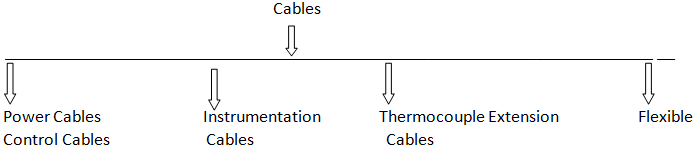
- Classification of Power cables as per working Voltage Grade & relevant Insulation:
-
Voltage Grade →
Up to 1.1 KV
3.3 KV to 33 KV
66 KV to 220 KV
Classification →
L V / LT Power Cables, Control Cables & Flexibles, Elastomeric Cables or Rubber Cables
HV / HT Cables
EHT / EHV Cables
IS Specification →
- IS 1554 P1 (PVC Insulated,)
- IS 7098 P1 (XLPE Insulated)
- IS 694 (PVC Insulated & sheathed)
IS 7098 P 2
(XLPE Insulated)
IS 7098 P 3
(XLPE Insulated)
-
Power Cables are sub classified into the following categories based on their construction:
-
- Armoured Cables (LT, HT & EHV)
- Un- Armoured Cables (LT & HT)
- Flexibles (LT)
-
Note:
-
- Flexibles, Control cables, Instrumentation & Elastomeric Cables essentially have copper conductors
- Flexibles are essentially without armouring
-
Types of Conductor as per IS 8130
-
Aluminium
EC Grade
- Conductor Size ≤ 10 mm2 Solid (Class 1) for Armoured /Un Armoured Cables
- Conductor Size > 10 mm2 Stranded (Class 2) for Armoured /Un Armoured Cables
Copper
Electrolytic Grade
- Conductor Size ≤ 6 mm2 Solid (Class 1) for Armoured /Un Armoured Cables
- Conductor Size ˃ 6 mm2 Stranded (Class 2) for Armoured /Un Armoured Cables
- Class 5 / Class 6 for Flexibles of all sizes
-
Types of Insulation: PVC (FR PVC, FRLSH PVC, HR PVC etc) as per IS 5831 (Applicable also as sheathing material), XLPE, XLPO etc.
-
Types of Armouring used as per IS 3975
-
Aluminium Round Wire
Aluminium Flat Strip
Galvanized Wire
Galvanized Strip
All single Core Cables
1C X 16 mm2 to 1C X 70 mm2
All single Core Cables
1C X 95 mm2 to 1C X 1000 mm2
2C X 10 mm2, 3C X 10 mm2, 4C X 6 mm2
Up to 10C X 1.5 mm2
Up to 8C X 2.5 mm2
All other sizes from
2C X 16 mm2
3C X 16 mm2
4C X 10 mm2
3.5C X 25 mm2
-
Flexible: IS 694
-
(Working voltage up to 1.1 KV)
-
- Conductor: Annealed Copper Conductor (IS 8130 Class 2 or Class 5 )
- Insulation: PVC (FR PVC, FRLS-H, HR PVC) as per IS 5831 & ZHLS
- Outer Sheath (In case of multi-core flexible)
-
Instrumentation Cables: BS EN 50288 - 7
-
(Working voltage up to 500 V)
- Basic function of instrumentation cables is to transmit real time data in the form of electrical signals between functional units that are integral parts of a defined process. Usually have applications in process industries like oil refineries, cement, paper, steel etc. where the all processes are interlinked and are required to be continuously monitored and controlled.
-
Components of Instrumentation cables:
- Conductor: Essentially Copper conductor as per IS 8130 Tinned/Un-tinned, Solid (Class 1) / Stranded (Class 2)/Flexible (Class 5) Copper conductor.
- Insulation: PVC, PE, XLPE & EPR.
-
Two insulated conductors are twisted in a uniform manner to form a pair. Similarly three such conductors are twisted to form Triads and four to form Quads. A Cable may have multiple pairs, Triads or Quads (e.g. 12P X 1.5 mm2, 8T X 1.5 mm2 and 4Q X 0.5 mm2). The Pairs/Triads/Quads may be:
- Un Screened
- Individually and Overall screened
- Overall Screened
-
- Screening Material: Aluminium Mylar Tape / Copper Tape / Copper Wire Braiding
- Armour: GI Wire / Strip or braided with wire
- Sheathing: PVC ST1/ST2, FRLS, ZHFR etc.
-
Elastomeric Cables or Rubber Cables: IS 9968 Part 1
(Working voltages up to 11 KV)
-
- Annealed Tinned Copper Conductor (IS 8130) Solid (Class 1), Stranded (Class 2) & Flexible (Class 5)
- Insulation: General Service Elastomeric compound (Type IE 1 of IS 6380)
Heat Resisting Elastomeric compound (Type IE 2 of IS 6380)
-
Silicone Rubber (Type IE 5 of IS 6380)
- Sheath:
- General Service Elastomeric compound (Type SE 1 of IS 6380)
- Heat Resisting Elastomeric compound (Type SE 2 of IS 6380)
Applications of Rubber/Elastomeric cables as Power Cables (up to 11 KV), Instrumentation Cables & Control Cables etc.:
-
- Sub Zero temperature applications
- High Temperature applications
- Chemical resistant applications
- Fire Survival
- Mining applications
- Material handling applications
- Wind energy
-
General nomenclature of cables: Symbolic designation of a cable starts from naming the conductor and then proceeding towards insulation, inner sheath armouring and the outer sheath.
-
S.No.
Component and type
designation
1
Copper Conductor
2
Aluminium conductor
A
3
PVC Insulation & PVC Sheath
Y
4
XLPE Insulation
2X
5
GI round wire Armour
W (and WW for double layer of GI round wire)
6
GI Flat Strip Armour
F (and FF for double layer of GI Flat Strip)
7
Aluminium round wire Armour
Wa
8
Aluminium Flat Strip Armour
Fa
9
Copper screen
C
-
Some Examples:
-
- YFY: Copper conductor (there is no designation for copper conductor), PVC Insulated (Y), Flat strip armoured (F) & PVC Sheathed (Y) cable.
- AYFY: Aluminium Conductor (A), PVC Insulated (Y), Flat Strip (F) and PVC Sheathed cable (Y)
- A2XWY: Aluminium Conductor (A), XLPE insulated (2X), Round Wire Armoured (W) and PVC Sheathed (Y) Cable
- 2XYFY: Copper Conductor, XLPE Insulated (2X), Flat Strip Armoured (F), PVC Sheathed (Y) Cable
- A2XCYFY: Aluminium Conductor (A), XLPE Insulated (2X), Screened with Copper tape (C), PVC Sheathed (Y), Flat Strip Armoured (F), PVC Sheathed (Y) Cable.
- YY: Copper Conductor, PVC Insulated (Y), PVC Sheathed (Y) Un Armoured Cable.